Adjustable Weight Vest - Black
Adjustable Weight Vest - Black
In stock
Couldn't load pickup availability
 @gymgeneration
Lookbook
@gymgeneration
Lookbook
Three weight levels, removable plates, and a closure system that doesn’t shift on pull-ups: the Gym Generation weight vest turns any bodyweight movement into progressive overload – in the gym, at the calisthenics park and outdoors. And it carries what no other vest carries: your patches.
The short version: The Gym Generation weight vest is an adjustable training vest in 900D Oxford nylon with a plate carrier cut, a laser-cut MOLLE grid and removable weight plates in three levels: 1.5 kg (vest without plates), 6.5 kg (2 × 2.5 kg) and 9.5 kg (2 × 4 kg). A padded shoulder section, breathable mesh lining, elastic drawcord and Velcro straps that adjust anywhere keep it in place on pull-ups, push-ups and jumps – one size, it adapts to any torso. The Velcro front takes swappable patches, and the Spartan patch is included. From CHF 99, shipped from Switzerland.
Technical Data
A Velcro Front for Your Patches
The front carries a large Velcro zone on a laser-cut MOLLE grid – the same patch system as on our gym backpacks. The Spartan patch comes with every vest, and you will find more designs in the patch collection. No second vest in the gym looks like yours.
Which Weight for Which Training
More is rarely better with a weight vest: added load hits harder on bodyweight movements than the number suggests.
Looking for 15, 20 kilos or more? Then a loaded backpack is the right tool – this vest is not built for rucking and march training under heavy load. For bodyweight training it is deliberately sized: 4 kg already changes a pull-up noticeably, and 9.5 kg is years of progression for most athletes.
Training With the Weight Vest
Added load is the most direct way to make bodyweight training harder without changing the movement. That is what weight vests are built for: the movement stays the same, only the resistance grows with you.
- Pull-ups and dips: 2.5 to 4 kg already moves you by several reps – the classic entry into weighted calisthenics.
- Push-ups: more load on chest, shoulders and triceps with an identical movement.
- Squats and lunges: load legs and glutes progressively, with no barbell at all.
- Circuits, HIIT and burpees: higher heart rate and higher energy expenditure in the same workout.
- Skills: prepare muscle-ups with added weight and the movement gets easier without the vest.
How to build a full programme from that is covered in our calisthenics guide.
Walking and Rucking With a Weight Vest
The underrated side of vest training: walking with weight. At 6.5 kg a walk, a hike and the stairwell turn into quiet endurance work – easier on the joints than running and built into the day without a separate session. That is what rucking is: sustained load at moderate intensity, step after step over a longer distance instead of in short sets.
Fit
An elastic drawcord and Velcro straps pull the vest close to your torso – it sits like a plate carrier, not like a backpack. The plates stay against the body instead of swinging, and that is what decides whether a vest stays quiet on pull-ups or works against you.
Weight Vest – Frequently Asked Questions
Is a weight vest worth it?
It earns its place the moment your own bodyweight stops being enough resistance. Someone who manages fifteen clean pull-ups does not get stronger from the sixteenth – but from the same eight with 6.5 kg, they do. It replaces neither technique nor a training plan, and it will not turn an easy workout into a hard one. As a tool for progressive overload in bodyweight training, though, it is one of the few that genuinely changes something.
How heavy should a weight vest be?
The exercise decides that, not your ambition. For walking, hiking and stairs, around 5–10 % of bodyweight is the usual range. For pull-ups and dips, go by reps: pick a load that still leaves you six to ten clean repetitions – for most people that means 2.5 to 4 kg to start. If you are still working on technique, start at 1.5 kg. When in doubt take the lighter step: four kilos on a pull-up bar feel nothing like four kilos on a dumbbell.
What does a weight vest do for muscle growth?
It makes bodyweight movements progressive: instead of adding reps, you add load. Pull-ups, dips and push-ups stay in the rep range that builds muscle, even once your own bodyweight is long past being enough.
Can I change the weight?
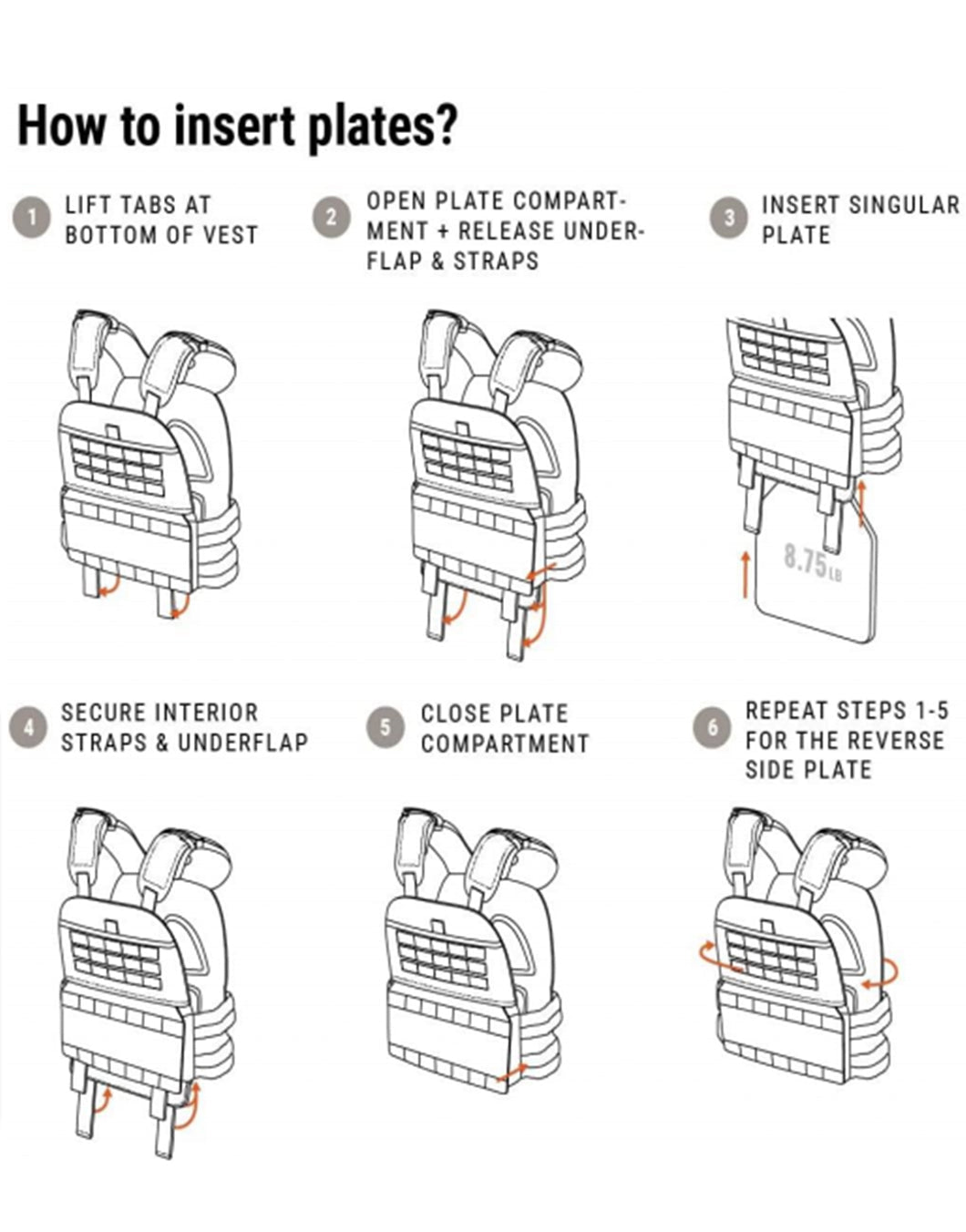
Yes, the plates come out. The 6.5 kg vest trains at 1.5, 4 or 6.5 kg, the 9.5 kg vest at 1.5, 5.5 or 9.5 kg.
Does the vest shift on pull-ups or jumps?
No. The elastic drawcord and Velcro straps pull the vest close to your torso, and the padded shoulder section stops it rubbing – on burpees, jumps and hanging positions too.
Does the vest fit every body size?
Yes. The vest comes in one size and adapts to any torso through the elastic drawcord and Velcro straps that adjust anywhere.
What is the MOLLE grid for?
The laser-cut grid turns the front into a surface you kit out: patches on the Velcro zone, accessories through the loops. It is the same build as a plate carrier, and it is why the vest does not look like a padded standard vest – and why no two in the gym look the same.
Is a weight vest good for running?
It is not built for it. Running raises the impact load on knees, hips and ankles with every kilo, and the vest moves with every stride. For walking, hiking and stairs it is the right choice: there the weight acts as a constant load rather than an impact.
Should you wear a weight vest all day?
For limited stretches there is nothing against it – a walk, the commute, the stairwell. Wearing it for hours is a different matter: the load changes your posture, and what was meant as a training stimulus becomes a constant demand on shoulders and neck. Put the vest on deliberately for one session and take it off afterwards.
Can you lose weight with a weight vest?
A weight vest raises energy expenditure for the same movement: a walk with 6.5 kg costs more than the same walk without. The difference is real but moderate. Body composition is decided first and foremost by diet, not by equipment. What the vest is built for is making you stronger – that walking with weight burns more than walking without is a side effect, not a programme.
Weight vest, weighted vest, training vest – what is the difference?
None. Weight vest, weighted vest, training vest, workout vest, gym vest or weight jacket all describe the same piece of kit – a vest with built-in weight plates that makes bodyweight movements, walking and circuit training harder.
How do I care for the weight vest?
Take the plates out, wipe the vest with a damp cloth and let it air dry. Do not put it in the washing machine.
Gym Generation has been developing training gear in Switzerland since 2013. You will find more tools for bodyweight training under calisthenics equipment.