Premium Leather Weightlifting Belt - Brown
Premium Leather Weightlifting Belt - Brown

Couldn't load pickup availability
 @gymgeneration
Lookbook
@gymgeneration
Lookbook
Leather Weightlifting Belt 9 mm – Hold and Stability for Heavy Lifts
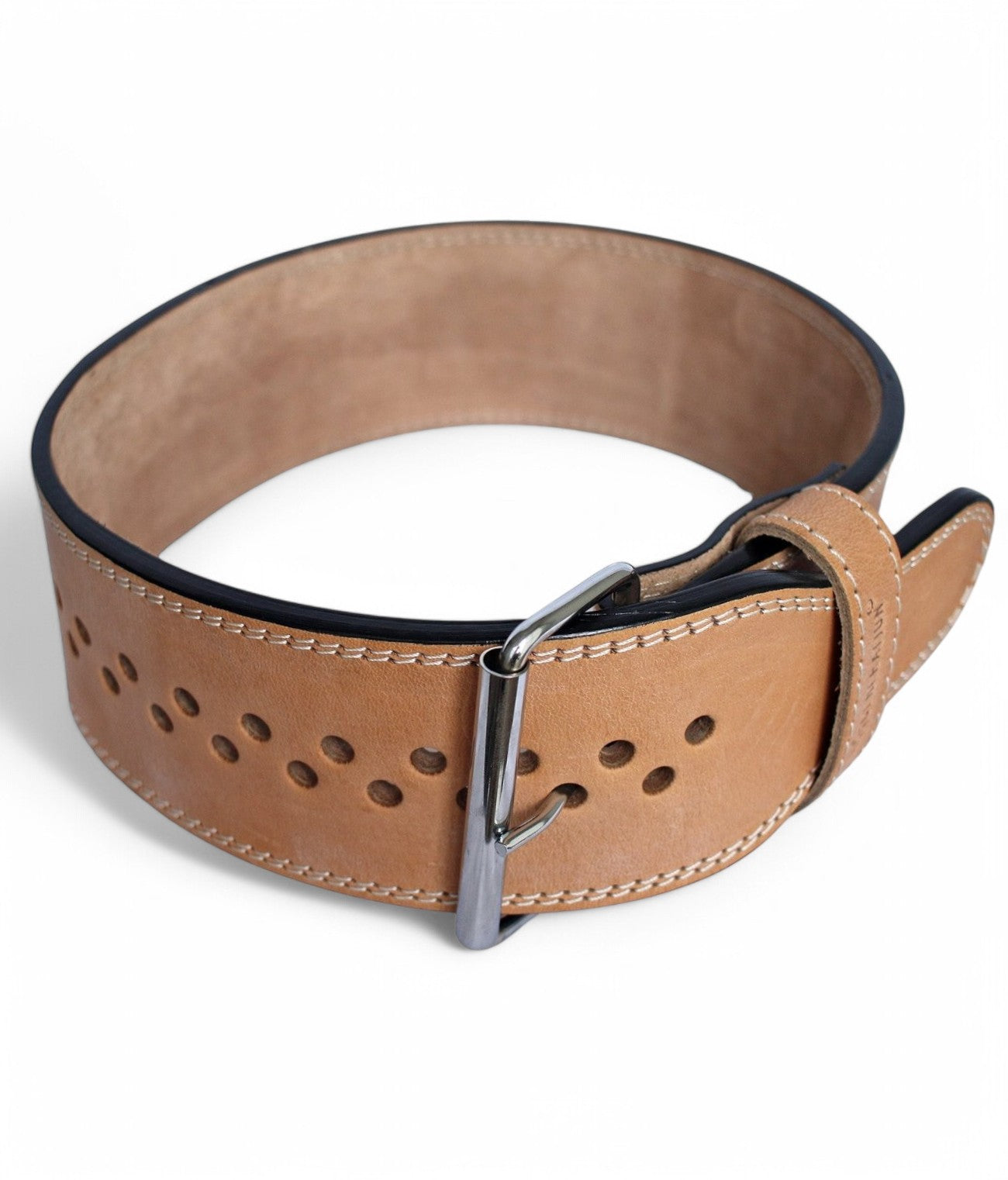
The Gym Generation weightlifting belt is made from 9 mm thick brown genuine leather and supports your core on deadlifts, squats and heavy strength training. The leather band, around 10 cm wide, runs the same width all the way round and gives your abdominal and lumbar muscles a firm surface to brace against, which raises the pressure through your core and gives you more stability under the bar. With a stainless steel prong buckle and a double row of holes, available in sizes S to XL for men and women.
Made for anyone who trains heavy and with structure: powerlifting, bodybuilding and Olympic weightlifting. On the big compound lifts, where the core becomes the stable base, the belt gives you the hold to move more weight under control. Shipped from Switzerland.
Thick Genuine Leather, Built for Heavy Loads
The belt is made from rugged brown genuine leather at 9 mm thick, one of the thickest and stiffest versions in our range. That material thickness gives maximum supporting force and almost no give under high load, ideal for very heavy sets. The leather is firm at first and shapes to your body over time. Heavy-duty double stitching holds the leather together even under high tension, and the embossed Gym Generation Spartan logo gives it its look. A belt that does not go soft over the years, but gets better.
Around 10 cm Wide, the Same All the Way Round
The belt is not contoured; it runs the same width around the full circumference – around 10 cm at the back and at the front. That is the powerlifting build, and there is a reason for it. A contoured belt supports mainly at the back; a straight one gives you the same surface all round to brace against, including at the front across the abdomen, where the pressure builds as you press. That is exactly where you want resistance. The 10 cm match the width that counts as standard in competition powerlifting.
Sealed Edges and a Stainless Steel Buckle
The edges at the top and bottom are sealed and colour-contrasted, which protects the leather from fraying and gives the belt a clean finish. The adjustable stainless steel prong buckle holds the belt securely in place, even under heavy load. The double row of holes allows a precise setting, so the belt sits exactly where you need it and does not slip.
How to Use the Weightlifting Belt Properly
A belt only works if you work against it. It sits above the iliac crest and below your lower ribs – tight, but with enough room to still breathe into your belly. Before the repetition, breathe deep into the stomach, not into the chest, and push your abs outwards against the leather. You hold that tension through the repetition. Loosen it between sets. With a 9 mm belt in particular you notice the difference immediately: the leather does not give, so you have a real wall to brace against.
A Gym Belt for Men and Women
The belt is cut unisex and adjusts in both directions via the prong buckle. As a gym belt for men and for women it covers the same use – what matters is your waist circumference, not your gender. The four sizes from S to XL run from 63 to 111 cm.
Gym Belt, Weight Belt, Training Belt – All the Same Thing?
In strength training, the terms all mean the same product. Whether you say weightlifting belt, lifting belt, gym belt, weight belt, training belt, power belt or powerlifting belt, what is meant is the wide belt you brace your abs against as you lift. What is not meant is a dip belt with a chain, which you attach extra weight to – that is a different product.
For Powerlifting, Weightlifting and Bodybuilding
As a bodybuilding belt it usually goes on for the heavy working sets and comes off again afterwards; in powerlifting it is a fixed part of the setup for squats and deadlifts. In Olympic weightlifting it gives hold on the clean and jerk and the snatch. Wherever the core forms the base for the movement, the stiffness of 9 mm makes the difference. If you want a softer, padded belt for long sessions, you will find it in our 6 mm models with a padded inner side.
Weightlifting Belt – Frequently Asked Questions
Which size do I need?
Measure your waist circumference at navel height, not your trouser size. The two often differ by several centimetres. S fits 63 to 81 cm, M 73 to 91 cm, L 83 to 101 cm, XL 93 to 111 cm. Where the ranges overlap, the smaller size gives the firmer fit.
How does a weightlifting belt work?
As you lift, you brace your abdominal muscles against the belt. That firm surface raises the pressure in your abdomen and gives your core more stability, so you work more controlled and more upright on heavy compound lifts.
How tight should the belt sit?
Tight enough that you feel resistance immediately when you brace, but loose enough that you can still breathe into your belly. If you cannot take a deep breath, it is too tight. Loosen it again between sets.
How thick is the belt?
The leather is 9 mm thick, which puts it among the thickest and stiffest models in our range. That material thickness gives you maximum supporting force and almost no give under high load – the right choice for powerlifting and very heavy compound lifts. If you want a slightly more flexible, more adaptable belt, our 6 mm models are the better fit.
How wide is the belt?
Around 10 cm, and the same all the way round. Unlike contoured belts, which are only wide at the back, this straight build gives you the same surface to brace against everywhere, including at the front across the abdomen. That is the shape that counts as standard in powerlifting.
Is the belt competition legal?
By its measurements, yes: at around 10 cm wide and 9 mm thick it sits within the limits set by federations such as the IPF. The IPF, however, only permits brands listed on its own approved list in competition, and Gym Generation is not registered there. For training, for the gym and for formats without an equipment list, that changes nothing. Check the current rulebook of your federation before entering.
What material is the belt made of?
9 mm thick brown genuine leather with heavy-duty double stitching and sealed edges. The leather is firm at first and shapes to your form over time; the stainless steel prong buckle holds securely even under heavy load.
At what point do you need a weightlifting belt?
Not from a particular weight onwards, but from the point where the compound lifts genuinely challenge you and your technique is solid enough to build core tension deliberately. You do not need it for warm-up sets and isolation work, and training part of the time without a belt keeps the core musculature working.
Which exercises is the belt worth it for?
Above all for heavy compound lifts like squats, deadlifts and Olympic lifts, where the core forms the base. On light sets and isolation exercises you generally do not need it.
How do I care for the leather belt?
Wipe it with a dry or slightly damp cloth and store it dry. Genuine leather should not be soaked, so it stays supple and stable for a long time.